


Corporate Event Transportation Planning Guide:

How to Move VIPs, Speakers, Clients, and Teams Seamlessly
Corporate event transportation is one of the most visible parts of the guest experience — and one of the easiest to underestimate.
When a keynote speaker is delayed, a VIP client cannot find their chauffeur, a board member arrives late, or a group transfer misses the event schedule, transportation quickly becomes more than a logistics issue. It becomes a brand experience issue.
Whether you are planning a leadership summit, investor roadshow, conference, client dinner, board meeting, product launch, or multi-day corporate program, the right ground transportation plan can help keep executives, speakers, clients, and attendees moving with confidence.
This guide explains what to consider before booking corporate event transportation — and how to build a plan that supports your schedule, your guests, and your company’s reputation.
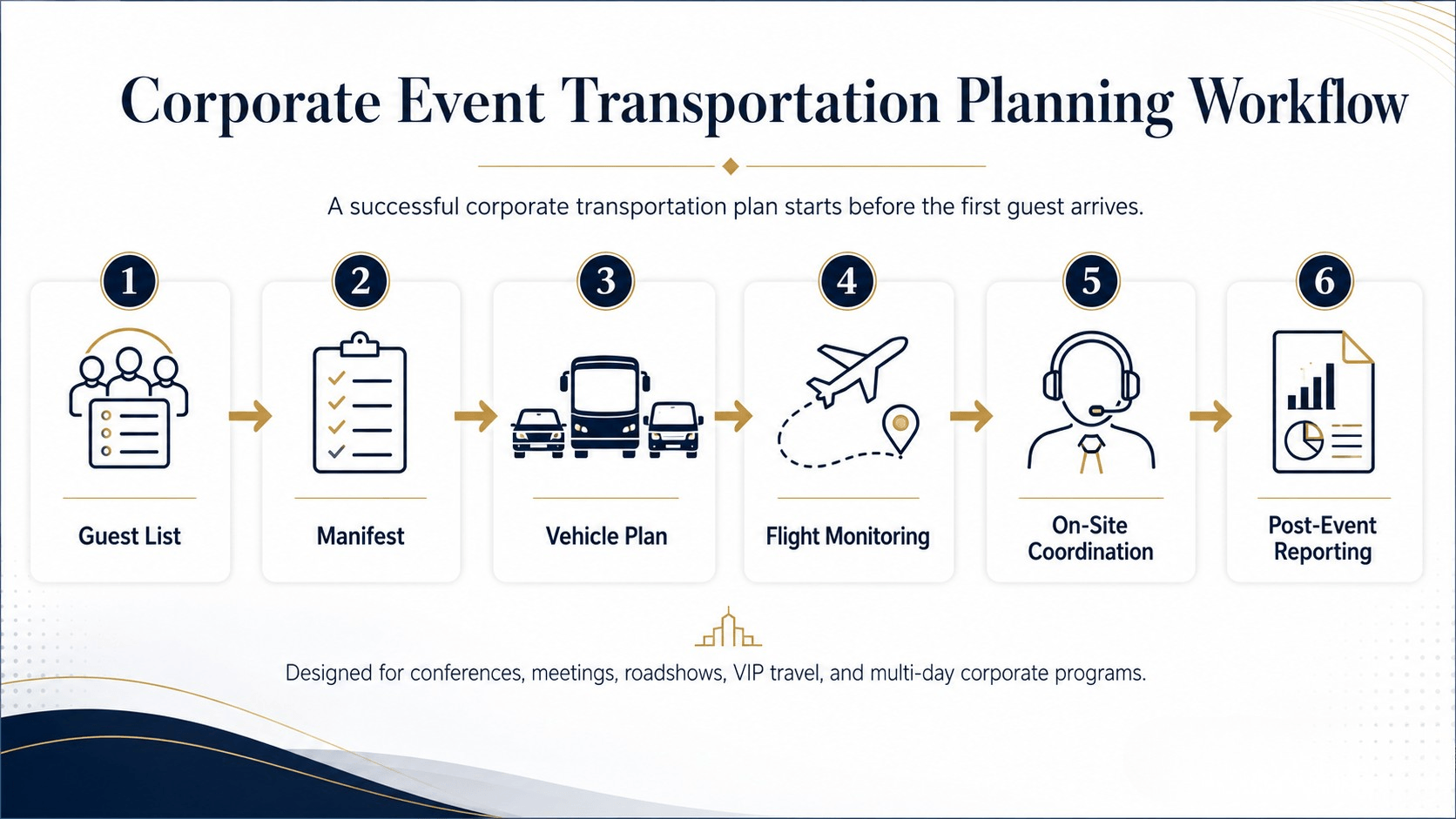
A seamless guest experience starts before the first arrival.
Who This Guide Is For
This guide is designed for anyone responsible for planning or supporting corporate event transportation, including corporate event planners, meeting planners, executive assistants, travel managers, marketing teams, investor relations teams, procurement teams, office managers, and conference coordinators.
If your event involves executives, clients, speakers, employees, attendees, or VIP guests, ground transportation should be part of the planning process early — not finalized at the last minute.
1. Start With the Business Impact of Transportation
Before selecting vehicles or confirming pickup times, start with a larger question:
What role does transportation play in the success of this event?
For some events, the priority is discretion and executive-level service. For others, it is moving a large group efficiently between hotels, venues, offices, restaurants, and airports. In many cases, it is both.
Transportation may influence:
- Guest arrival experience
- Executive schedules
- Speaker readiness
- Client impressions
- Event timing
- Security coordination
- Attendee satisfaction
- Internal team workload
For senior executives, board members, VIP clients, investors, keynote speakers, or media guests, transportation may be the first and last impression of your event. A professional chauffeur, clean vehicle, clear pickup instructions, and smooth arrival experience can help set the right tone before the guest ever enters the venue.
For larger groups, the goal may be organization, timing, and clarity. Attendees need to know where to go, when to be ready, and who to contact if travel plans change.
A strong event transportation plan should account for both the individual VIP experience and the broader group movement strategy.
2. Build a Complete Event Transportation Manifest
For corporate events, the transportation manifest is the foundation of the plan.
A well-prepared manifest gives your planning team, transportation provider, greeters, coordinators, dispatchers, and on-site contacts a shared source of truth.
Your event transportation manifest should include:
- Guest names
- Mobile numbers or assistant contacts
- Flight numbers
- Arrival and departure times
- Pickup and drop-off locations
- Vehicle type
- VIP status
- Special instructions
- Luggage or equipment notes
- On-site contact information
- Billing or department codes
- Contingency notes
This level of detail helps reduce last-minute confusion when flights change, meetings run long, weather affects arrival times, or guests require additional support.
For complex programs, working with a transportation partner that can help prepare, manage, and adjust the manifest can save valuable time for internal teams and improve the overall guest experience.
3. Map Every Guest Movement Before the Event Begins
Corporate event transportation often involves more than one airport transfer.
Common transportation needs may include:
- Airport arrivals and departures
- Hotel-to-venue transfers
- Executive and VIP transportation
- Speaker and panelist transportation
- Client dinners and off-site events
- Team outings or hospitality events
- Board meeting transportation
- Investor roadshow transportation
- Conference shuttle service
- Multi-day event transportation
- Shuttle service between hotels, offices, venues, or event spaces
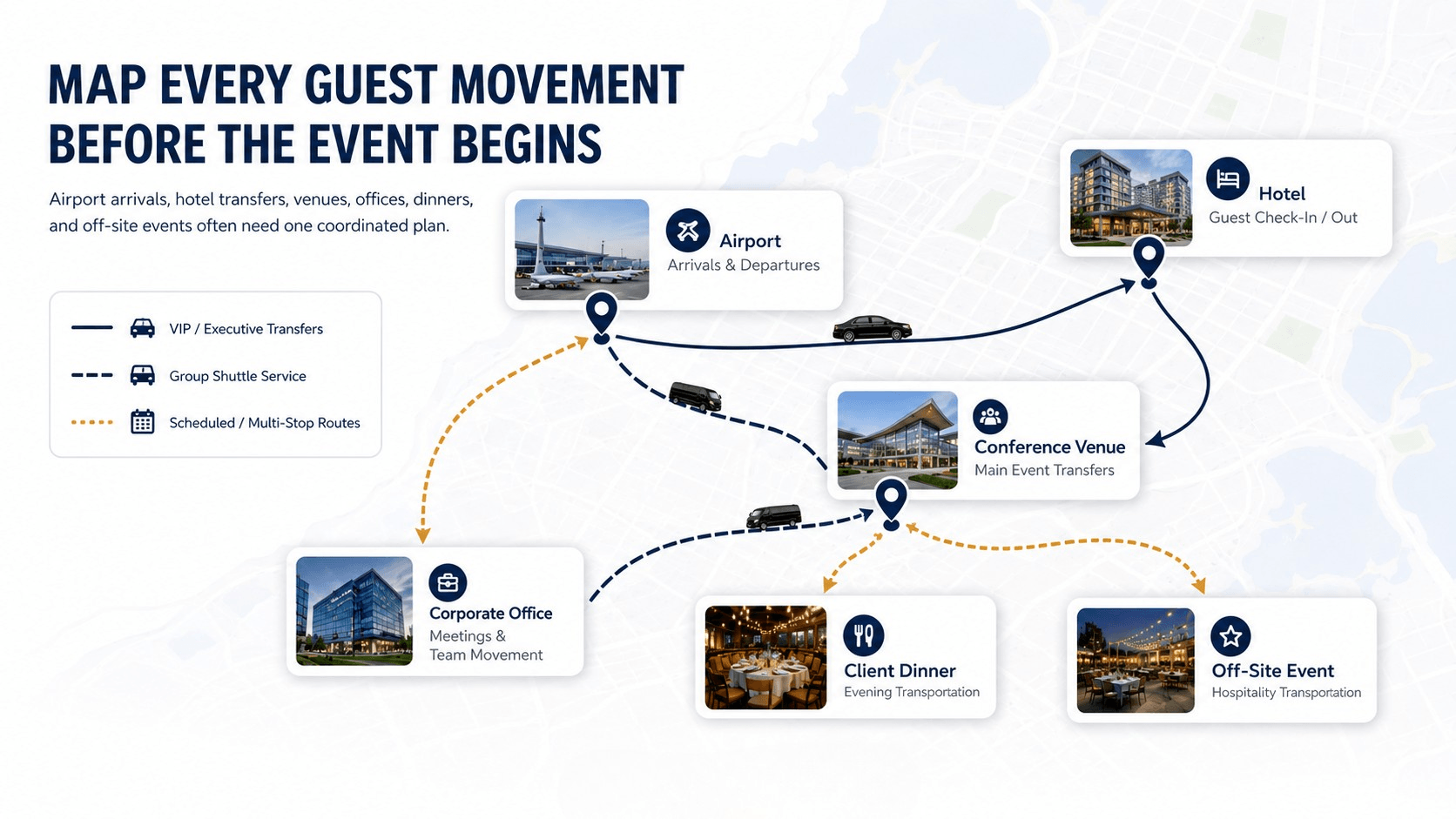
Corporate events often involve multiple guest types, locations, and schedules.
Mapping every movement early helps identify where you need private vehicles, shared shuttles, larger vehicles, on-site coordination, staging areas, or dedicated support.
It also helps reduce last-minute decision-making, which is often where costs increase and service issues appear.
A good transportation plan should answer:
- Who is traveling?
- Where are they arriving from?
- Where do they need to go?
- When do they need to arrive?
- How much flexibility is required?
- Which guests require VIP handling?
- Which movements can be grouped together?
- Which transfers require private service?
The earlier these details are confirmed, the easier it is to design a transportation plan that supports the event schedule instead of reacting to it.
4. Plan for Flight Delays, Schedule Changes, and Real-Time Updates
Even the best-planned corporate event can change quickly.
Flights are delayed. Meetings run long. Executives add stops. A speaker arrives earlier than expected. A client dinner changes locations. Weather impacts traffic. A guest misses a connection. A VIP needs to leave before the group.
That is why corporate event transportation requires more than simply booking a vehicle. It requires coordination, visibility, and the ability to adjust.
When evaluating a transportation partner, look for support around:
- Flight tracking
- Real-time ride updates
- Passenger alerts
- Chauffeur communication
- Schedule adjustments
- Manifest updates
- On-site coordination
- After-hours support
For high-profile events, real-time communication can make the difference between a stressful transportation experience and a seamless one.
Your internal team should not have to chase every vehicle, update every guest manually, or solve every transportation issue on event day. A professional transportation partner should help manage those details with you.
5. Match the Vehicle Type to the Guest, Group, and Occasion
Not every event movement requires the same vehicle type.
A board member may need private executive sedan or SUV service. A group of attendees may require a shuttle, van, or bus. A speaker may need point-to-point service with extra time built into the schedule. A roadshow may require hourly service with a chauffeur who understands discretion, timing, and multi-stop coordination.
The right mix of vehicles can help balance service level, guest expectations, budget, and operational efficiency.
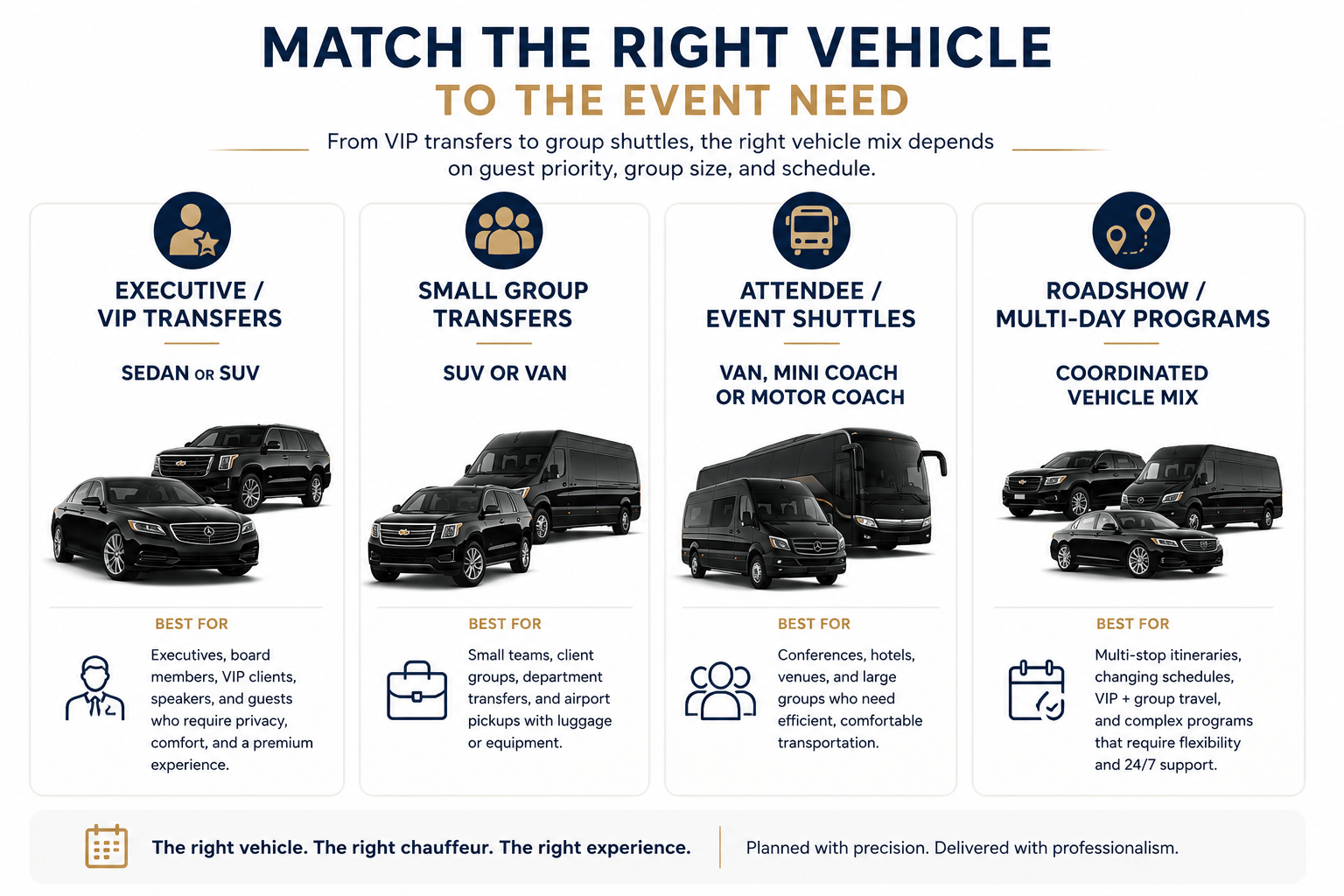
The right vehicle mix depends on guest priority, group size, schedule, and occasion.
Before assigning vehicles, consider:
- Who is traveling?
- Is the guest a VIP, speaker, executive, client, or attendee?
- How important is privacy?
- How many people are traveling together?
- How much luggage or event material is involved?
- Is the transfer time-sensitive?
- Is the itinerary fixed or likely to change?
- Would a shuttle create a better experience for the group?
Using the same vehicle type for every transfer may not be the best solution. A strong plan matches the transportation experience to the importance and purpose of each movement.
6. Create a Clear Communication Plan
Many event transportation problems are caused by unclear communication.
Guests may not know where to meet their chauffeur. Internal teams may not know whether a VIP has arrived. A speaker may have a new flight time, but the update may not reach the right person. A group may be ready to depart, but the shuttle staging location may not be clearly communicated.
Before the event, confirm how transportation information will be shared with guests and internal stakeholders.
Guest communication should include:
- Pickup time
- Pickup location
- Drop-off location
- Vehicle or chauffeur details
- Contact information
- Airport arrival instructions
- Hotel or venue instructions
- What to do if plans change
Internal communication should include:
- Transportation manifest access
- VIP arrival updates
- Event lead contact information
- Chauffeur or dispatcher communication process
- Escalation contacts
- Billing or account instructions
- On-site coordination details
Clear communication helps protect the guest experience and reduces the burden on executive assistants, event planners, travel managers, and on-site teams.
7. Account for Airports, Venues, Security, and Traffic Patterns
Corporate events often take place in busy environments: airports, hotels, convention centers, downtown venues, office campuses, private clubs, restaurants, stadiums, and event spaces.
Each location can create unique transportation challenges.
Airport congestion, loading zones, venue access rules, security checkpoints, valet areas, bus restrictions, road closures, and city traffic can all impact timing.
When building your schedule, allow time for:
- Airport arrival flow
- Baggage claim timing
- Customs or immigration for international travelers
- Hotel pickup volume
- Venue loading zones
- Security screening
- Downtown traffic
- Weather delays
- Large event traffic patterns
- Guest check-in or registration timing
A transportation schedule should be built around real-world conditions, not just map estimates.
For large events, even a small issue with staging, routing, or timing can create delays. Planning these details in advance helps keep guests moving and gives your team more control on event day.
8. Choose a Corporate Transportation Partner, Not Just a Car Provider
Corporate event transportation is different from casual event transportation.
The stakes are higher. Guests may include senior leaders, clients, investors, board members, speakers, media, employees, or high-value prospects. Service needs to be professional, discreet, reliable, and aligned with the expectations of the business.
A strong corporate transportation partner should bring more than vehicles.
Look for a partner that can support:
- Event planning
- Manifest management
- VIP transportation
- Airport arrivals and departures
- Group transfers
- Roadshows
- Shuttle programs
- Real-time updates
- On-site coordination
- Professional chauffeurs
- Flexible vehicle options
- Billing and reporting needs
- Multi-city or worldwide programs
This is especially important for companies planning multiple events throughout the year. When transportation is managed through a professional account structure, teams can benefit from more consistent booking, reporting, billing, traveler preferences, and ride visibility.
Corporate Event Transportation Checklist
- Guest list and VIP priority levels
- Airport arrival and departure details
- Hotel, venue, office, and off-site locations
- Vehicle types for each movement
- Group shuttle requirements
- Private executive transportation needs
- Speaker and client transportation
- Roadshow schedules and waiting time
- On-site contact names and phone numbers
- Greeter or coordinator requirements
- Billing instructions
- Backup plans for delays, traffic, weather, or schedule changes
The more complete the transportation plan is before the event begins, the less your team has to solve in real time.
Why Companies Choose Dav El | BostonCoach for Corporate Event Transportation
Dav El | BostonCoach helps companies plan and manage ground transportation for corporate events, meetings, conferences, roadshows, VIP travel, and group programs.
From individual executive transfers to complex multi-vehicle programs, our team can help create a transportation plan designed around your event schedule, guest experience, and business priorities.
Our Meetings & Events support includes transportation planning for events of different sizes, a dedicated Event Team, vehicle options including sedans, SUVs, vans, and buses, event manifests, ride tracking, pre-arrival alerts, and support for meetings and events worldwide.
For companies managing recurring travel or multiple business events throughout the year, a Dav El | BostonCoach Business Account can also help simplify booking, ride management, reporting, billing, traveler preferences, and account visibility.
Planning a Corporate Event? Let Us Review the Transportation Plan
Before you finalize your event schedule, make sure your ground transportation plan is built around the full guest experience.
Dav El | BostonCoach can help coordinate executive transfers, VIP transportation, airport arrivals, group shuttles, roadshow transportation, conference transportation, client dinners, and multi-day corporate event programs.
Whether you need a few executive vehicles or a larger event transportation plan, our team can help you build a professional, reliable solution for your guests.
Frequently Asked Questions About Corporate Event Transportation
What is corporate event transportation?
Corporate event transportation is planned ground transportation for business events, conferences, meetings, roadshows, client events, executive gatherings, and group programs. It may include airport transfers, VIP transportation, shuttle service, speaker transportation, and group transportation.
When should I book transportation for a corporate event?
Transportation should be planned as early as possible, especially if the event involves multiple airports, VIP guests, group transfers, buses, or several days of programming. Early planning helps secure the right vehicles, schedule, staffing, and logistics support.
What information is needed to plan event transportation?
You should gather guest names, arrival and departure times, flight numbers, pickup and drop-off locations, hotel and venue details, VIP status, vehicle preferences, luggage needs, billing details, and on-site contacts.
Do corporate events need private cars, shuttles, or both?
Many corporate events use a combination of private executive vehicles and group transportation. VIPs, speakers, board members, and clients may need private sedan or SUV service, while attendees or employees may be better served through shuttle, van, or bus options.
Why use a professional transportation company for corporate events?
A professional transportation company can support scheduling, vehicle coordination, guest communication, airport arrivals, real-time changes, manifests, billing, and on-site logistics. This helps reduce planning stress and improve the guest experience.