


How to Build a Corporate Ground Transportation Program Across Multiple Cities

Arranging a car for one executive in one city is relatively straightforward. Managing ground transportation for executives, employees, clients, and guests across dozens of cities is something very different.
As a corporate travel program expands, companies often accumulate transportation providers one market at a time. There may be a preferred provider in New York, another in Chicago, a different process for London, an executive assistant’s favorite company in Los Angeles, and rideshare filling the gaps in between.
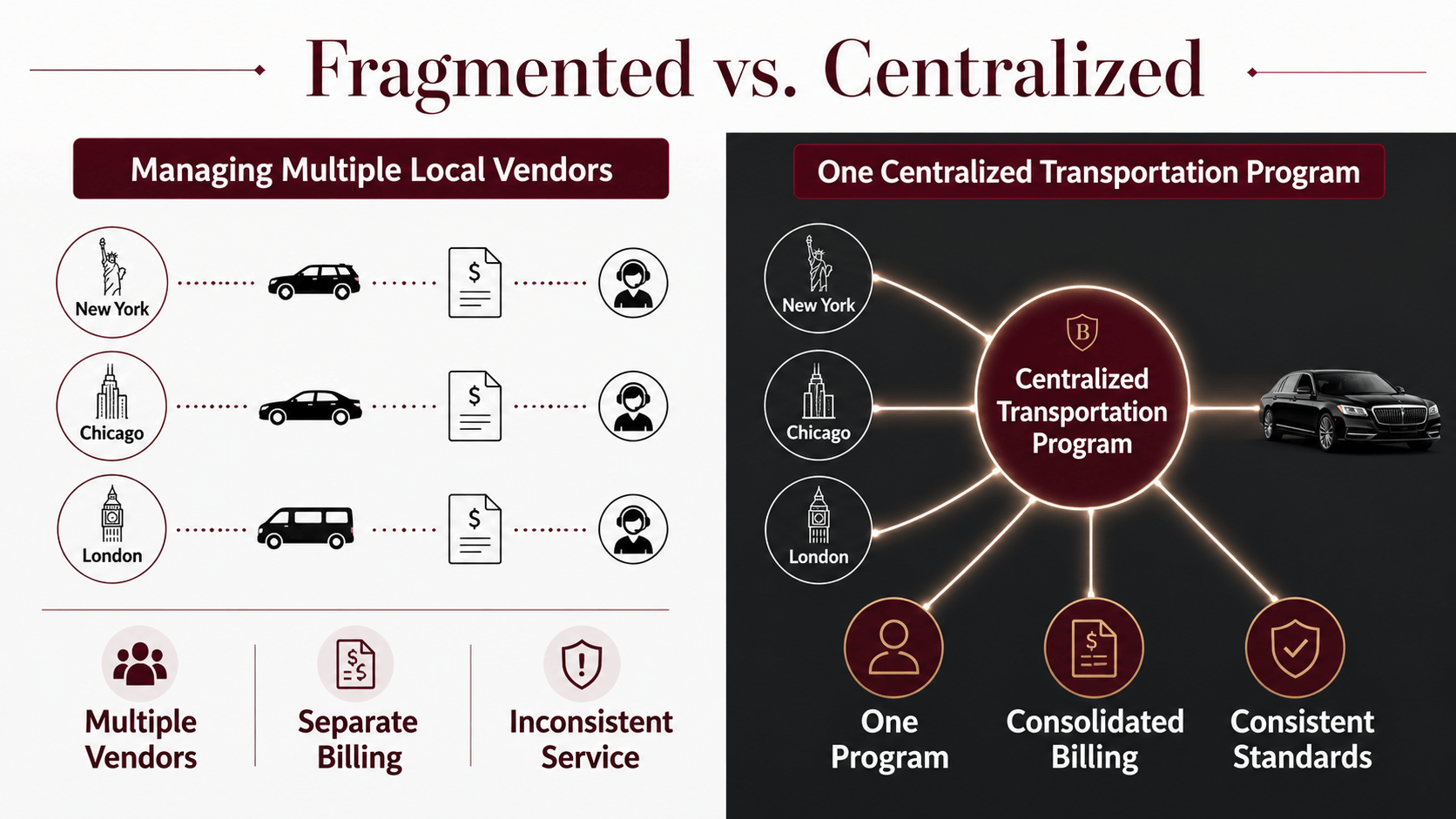
What begins as flexibility can eventually become fragmentation: different reservation processes, service expectations, contacts, invoices, policies, and levels of visibility depending on where a traveler happens to be.
That is when corporate ground transportation needs to evolve from a series of individual reservations into a managed travel program.
The goal is not to find a different car service in every city. It is to build one corporate ground transportation program that can work across every city your travelers need.
1. Start by Mapping Your Current Ground Transportation Program
Before consolidating anything, understand what is happening today. Ground transportation can be surprisingly decentralized because reservations may be made by travel departments, executive assistants, individual travelers, meeting planners, finance teams, or local offices.
A useful first step is creating an inventory of how your organization currently purchases and manages ground transportation.
At minimum, identify:
- The cities and countries where ground transportation is regularly used
- Current local and national transportation providers
- Approximate annual ride volume and transportation spend
- Airport transportation versus point-to-point and hourly trips
- Executive, board, client, and VIP transportation requirements
- Rideshare usage and other out-of-program bookings
- Meeting, conference, group, and shuttle transportation
- Roadshows and other complex multi-city itineraries
- Who is authorized to arrange transportation
- How reservations, receipts, invoices, and reporting are currently managed
This exercise often reveals that a company does not have one ground transportation process at all. It has multiple processes operating alongside one another.
2. Understand the Cost of a Fragmented Transportation Program
Using different transportation companies in different markets is not inherently a problem. Local expertise can be extremely valuable. The problem begins when the company itself has to manage every local relationship separately.
Operational Complexity
Travelers and arrangers may have different booking procedures, contact information, cancellation rules, and service expectations depending on the destination.
Procurement Complexity
More suppliers can mean more vendor reviews, contracts, negotiations, insurance documentation, payment processes, and ongoing relationship management.
Financial Complexity
Separate invoices, credit card charges, expense reports, currencies, and billing formats can make it harder to understand total corporate transportation spend.
Traveler Inconsistency
A traveler may receive excellent service in one city and a completely different experience in the next, even though both trips are part of the same corporate travel program.
Limited Visibility
Travel managers may struggle to see where employees are traveling, which providers are being used, and how much is being spent across markets.
Duty-of-Care Challenges
Consistently evaluating chauffeur, vehicle, insurance, safety, privacy, and service standards becomes more difficult as the supplier base expands.
3. Decide What Should Be Consistent in Every Market
Centralizing a global ground transportation program does not mean every trip must look exactly the same. A pickup at Heathrow Airport operates differently from one at Boston Logan, and transportation requirements in central Paris may differ from those in Los Angeles.
The goal is to establish company-wide standards while allowing transportation to be executed appropriately in each local market.
Organizations should consider establishing minimum expectations for:
- Chauffeur professionalism and screening
- Licensing and insurance
- Vehicle age, condition, cleanliness, and category
- Airport pickup and meet-and-greet procedures
- Flight monitoring
- Traveler and arranger communications
- GPS and ride-status visibility
- Wait-time and cancellation policies
- Privacy and information security
- VIP and executive protocols
- Issue escalation and service recovery
Consistency is particularly important for executives and frequent travelers. They should not have to relearn the transportation process every time they land in another city.
Companies evaluating these requirements should also consider how providers approach duty of care, chauffeur vetting, traveler tracking, data privacy, and safety
.
4. Create Traveler and Service Tiers
One of the most common mistakes in corporate travel transportation is assuming that every traveler and every trip requires the same service.
A better program defines transportation standards around the traveler, the purpose of the trip, and the service requirement.
| Travel Need | Potential Transportation Standard |
|---|---|
| Senior executive or board member | Premium executive sedan or SUV with enhanced traveler preferences and support |
| Employee airport transportation | Professional sedan or appropriate corporate vehicle category |
| Client or VIP guest | Chauffeured executive service designed to deliver a polished arrival experience |
| Executive roadshow | Dedicated hourly or as-directed vehicle with itinerary coordination |
| Small business group | SUV, van, or Sprinter-style vehicle based on passenger and luggage requirements |
| Conference or corporate event | Coordinated sedan, SUV, van, shuttle, mini coach, or motor coach program |
Creating these standards also helps procurement teams compare transportation providers more effectively because the company is evaluating vendors against defined business requirements rather than simply comparing individual ride prices.
5. Centralize Booking Without Taking Flexibility Away
A centralized transportation program should make travel easier, not add another layer of bureaucracy.
Ideally, travel managers, executive assistants, and authorized arrangers can work within one account structure while travelers still have practical ways to book and manage their rides.
Important capabilities may include stored traveler profiles, preferred pickup instructions, frequently used locations, payment methods, access for multiple travel arrangers, historical ride information, and the ability to adjust reservations when plans change.
Dav El | BostonCoach, for example, provides online, mobile, and phone booking and ride-management options
, while its corporate Account Center is designed to let authorized users book, manage, adjust, track, and report on business ground travel.
The key distinction:
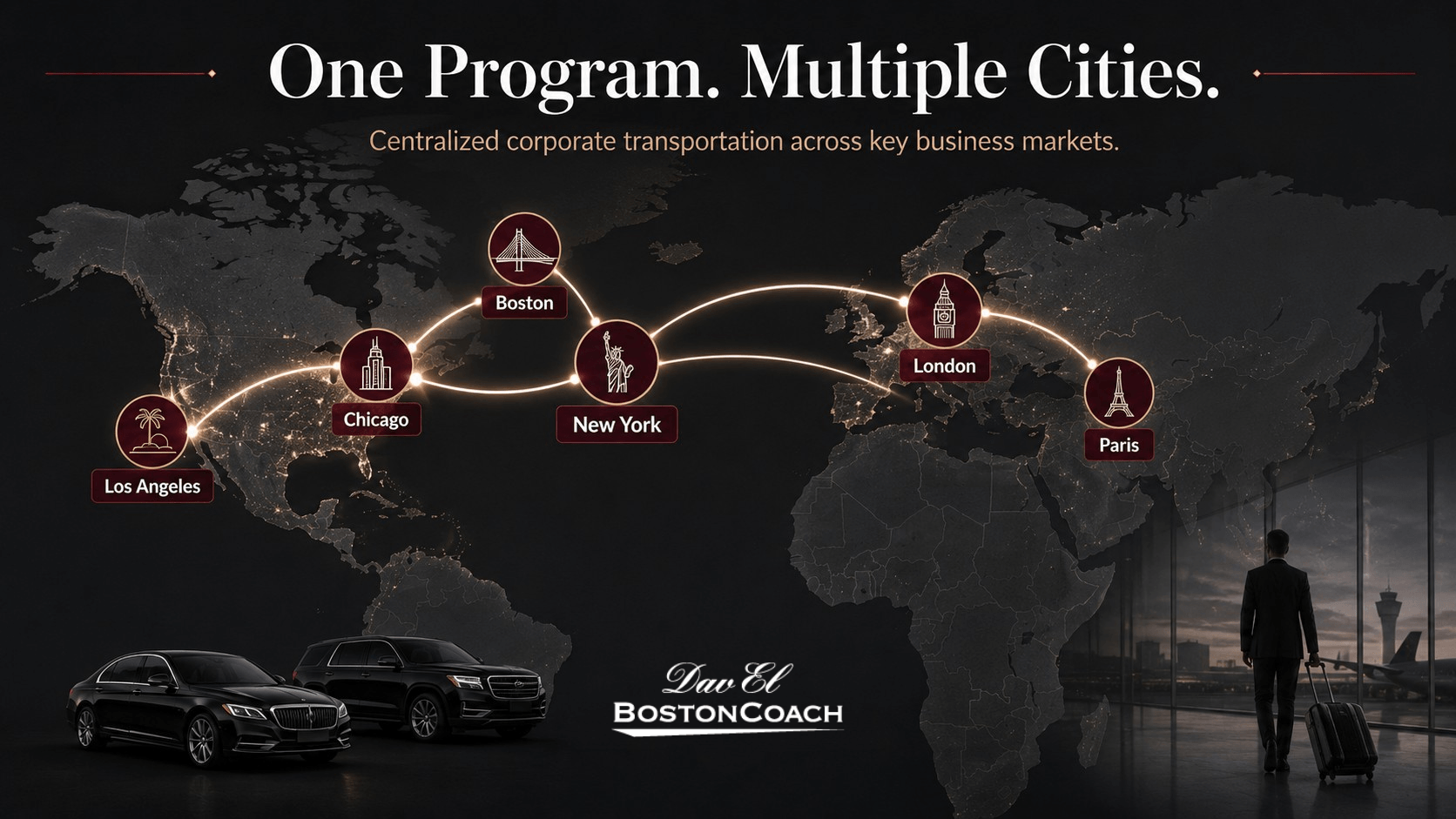
centralization should give the company greater control and visibility while giving travelers and arrangers fewer transportation relationships to manage.
6. Consolidate Billing, Reporting, and Spend Visibility
Procurement and travel teams should look beyond the reservation itself. How ground transportation is billed, allocated, analyzed, and reconciled can have a significant effect on program administration.
In a fragmented environment, a company might receive one invoice from its New York provider, another from Boston, separate credit card charges in Chicago, an international invoice from London, and employee expense reports from rides booked outside preferred channels.
A more centralized program can make it easier to understand total transportation activity and identify opportunities for improved policy compliance or supplier management.
Useful reporting may include:
- Transportation spend by city or market
- Spend by traveler, department, project, or cost center
- Ride volume by market
- Vehicle-category usage
- Airport versus non-airport transportation
- Cancellation and no-show activity
- Out-of-policy or exception activity
- Service trends and recurring issues
For companies looking to consolidate corporate transportation administration, Dav El | BostonCoach Business Accounts
include direct-bill options, centralized transportation management, traveler information, ride tracking, and customizable reporting and analytics.
7. Build the Program for Exceptions, Not Just Routine Trips
Most transportation reservations are relatively predictable. The real test of a corporate travel program comes when something changes.
- A cancelled or significantly delayed flight
- A meeting that runs an hour longer than expected
- A last-minute destination change
- An additional executive joining the trip
- A vehicle requirement changing because of luggage or passenger count
- A weather disruption affecting an entire city
- A conference or major event creating unexpected traffic restrictions
- A multi-stop itinerary changing during the day
The question is not only, “Can the provider handle the reservation?” It is also, “What happens when the reservation changes?”
Travel managers should understand who is available to assist travelers, how after-hours changes are handled, what information the support team can see, and how quickly service issues can be escalated.
Dav El | BostonCoach provides customer support around the clock and offers flight tracking and real-time ride information designed to help travelers and arrangers respond when plans change.
8. Plan for Transportation That Goes Beyond Airport Transfers
A strong corporate ground transportation program should support routine business travel while also being able to scale for more complex requirements.
- Executive and investor roadshows
- Board meetings
- Client entertainment
- Private aviation and FBO transfers
- Corporate conferences
- Hotel-to-venue shuttle programs
- Group airport arrivals and departures
- Speaker and VIP transportation
- Multi-day events
- International business travel
These are exactly the situations where managing individual local providers can become especially time-consuming. A conference may require sedans for executives, SUVs for airport pickups, vans for small teams, and coaches for larger groups—all operating on coordinated schedules.
Companies with these needs should evaluate whether a transportation partner can support both everyday travel and specialized programs such as meetings and events transportation and corporate roadshows.
9. Know When Local Providers Still Make Sense
Centralization does not necessarily mean eliminating every local transportation relationship.
A company may already have an excellent local provider in a specific market. The provider may know the company’s travelers, understand local airports and venues, and consistently deliver strong service at an appropriate cost.
The larger question is whether the organization should continue managing every local transportation relationship independently as its travel program grows.
A sophisticated nationwide or global transportation model can combine centralized program management with knowledgeable local execution. The organization gains greater consistency, visibility, and administrative simplicity without giving up the local expertise that is important to the actual ride experience.
10. Measure the Ground Transportation Program
Once ground transportation is treated as a program, it can also be measured as one.
The exact KPIs will depend on your organization, but travel and procurement teams may want to track:
Measurement creates an opportunity to move supplier conversations beyond anecdotes. Instead of asking whether travelers seem satisfied, companies can evaluate actual program performance and identify markets or processes that require attention.
11. What to Look for in a Multi-City Ground Transportation Partner
Once the company understands its current program and defines its standards, procurement can evaluate potential partners against the requirements that actually matter.
- Geographic coverage: Can the provider support the cities and airports your organization uses today—and the markets it may need tomorrow?
- Service standards: How are chauffeurs, vehicles, safety requirements, and service expectations managed?
- Local capabilities: Does broad coverage still provide appropriate local market knowledge?
- Booking technology: Can travelers and arrangers easily create, update, and monitor reservations?
- Traveler communication: What information is available before and during the ride?
- Account management: Who helps the company optimize the relationship over time?
- Billing and reporting: Can transportation activity be centralized and analyzed?
- 24/7 support: Is assistance available when travelers need it?
- Executive capabilities: Can the provider support senior executives, board members, VIP guests, and private aviation?
- Meetings and events: Can it scale from individual rides to coordinated group movement?
- Roadshows: Can the provider manage high-pressure, multi-stop itineraries?
- International support: Can the program extend beyond domestic business travel?
12. Building a Multi-City Program with Dav El | BostonCoach
Dav El | BostonCoach provides corporate chauffeur and ground transportation services for executives, employees, board members, clients, meeting attendees, and VIP guests.
The breadth of that network is particularly relevant for organizations trying to reduce the number of transportation relationships they manage while maintaining service across major domestic and international business markets.
Corporate programs can combine centralized account management with professional chauffeured service, multiple booking options, traveler profiles, ride-status information, reporting, airport transportation, executive service, roadshows, meetings, events, and group transportation.
Companies can also explore Dav El | BostonCoach’s worldwide city network to determine where service is available for their current and future travel requirements.
Corporate Ground Transportation Program Checklist
Before evaluating or redesigning your company’s transportation program, make sure you can answer the following:
Corporate Ground Transportation FAQs
What is a corporate ground transportation program?
A corporate ground transportation program is a structured approach for managing business transportation across an organization. It can establish preferred providers, traveler and vehicle standards, booking procedures, billing requirements, reporting, duty-of-care expectations, and support processes for airport transfers, executive travel, meetings, events, roadshows, and other business trips.
Why should companies centralize ground transportation across multiple cities?
Centralization can reduce the number of supplier relationships travel and procurement teams need to manage while improving consistency, traveler support, billing, reporting, program visibility, and the ability to establish common service standards across markets.
Does a global ground transportation program eliminate local expertise?
It should not. The strongest model combines centralized program management with local execution. Travelers still benefit from chauffeurs and operating teams who understand local airports, traffic patterns, venues, regulations, and market-specific requirements.
What should procurement consider when evaluating a nationwide car service or global transportation provider?
Procurement teams should consider geographic coverage, chauffeur and vehicle standards, licensing and insurance, safety, technology, traveler communications, account management, billing, reporting, 24/7 support, airport expertise, executive transportation capabilities, group and event support, and how the provider handles service issues and last-minute changes.
Managing Ground Transportation Across Multiple Cities?
If your organization is managing multiple transportation providers, inconsistent service standards, fragmented billing, or limited visibility into corporate ground transportation, it may be time to evaluate a more centralized approach.
Dav El | BostonCoach can help you build a professional ground transportation program designed around your travelers, markets, service requirements, and business needs.